
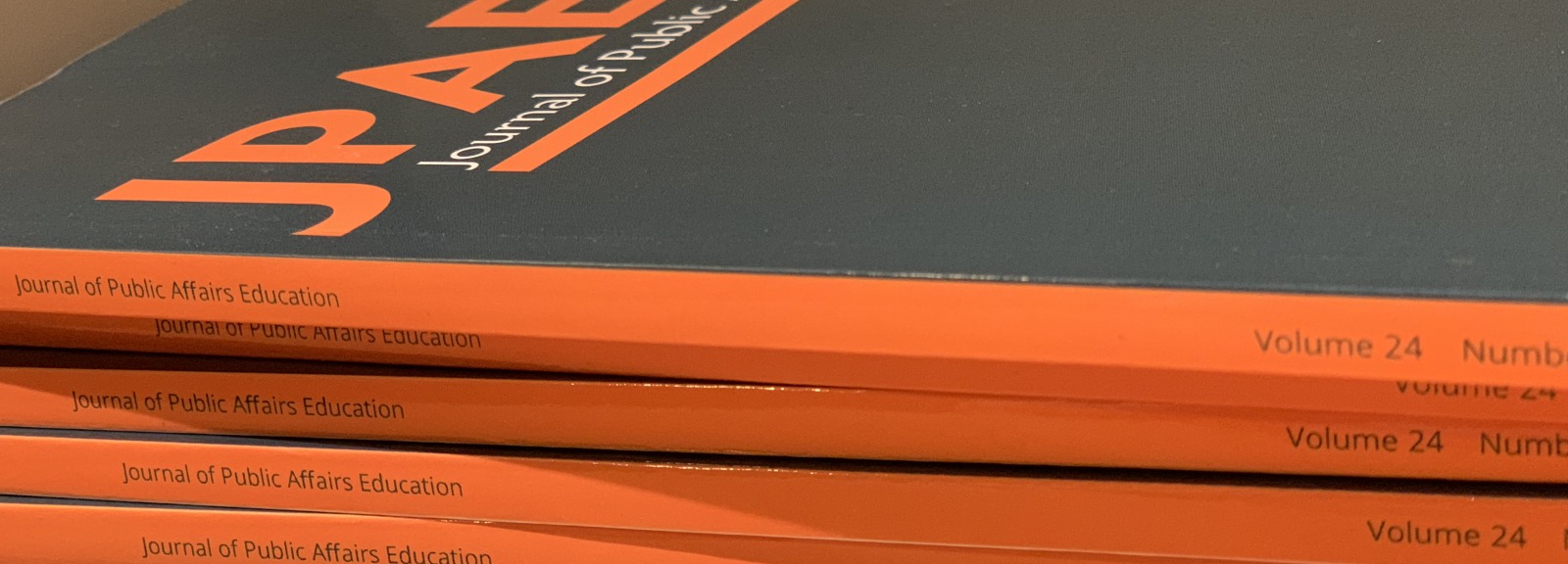
JPAE
Recent JPAE Articles

Preparing the Next Generation of AI-Savvy Public Affairs Professionals

Are the Students Alright? Faculty Adoption of Trauma-Informed Pedagogy in Public Affairs Education

“’Don’t Talk to Anyone, Don’t Touch Anyone’: Teaching Public Trust in the MPA Classroom Using a Simulation Based on the Film Contagion
Journal of Public Affairs Education
The Journal of Public Affairs Education (JPAE) is dedicated to advancing the scholarship of teaching and learning and public administration education, including public policy analysis, public administration, and public management. JPAE is the official journal of the Network of Schools of Public Policy, Affairs, and Administration (NASPAA). Supported by Kennesaw State University and Northern Arizona University, the quarterly journal features peer-reviewed scholarly articles on pedagogical, curricular, and accreditation issues in public affairs education.
Public affairs is a field of practice, and as practitioners and scholars, we must engage in discussions that seek to strengthen instruction. JPAE fulfills a vital role in our field by serving as the top research journal for this dialogue on pedagogy. The journal's mission is to be a forum for scholarly discussions on teaching public affairs programs. The journal welcomes theoretical and empirically based manuscripts that substantively contribute to public affairs education including pedagogy in public affairs programs; the administration of public affairs programs; issues impacting public affairs faculty; trends in the field; case studies that illustrate NASPAA curriculum standards and public administration principles in practice; and other vital topics.
Editors
Editor-in-Chief:
Sarah L. Young, Kennesaw State University
Associate Editors:
Sungdae Lim, Sam Houston State University
Ana-Maria Dimand, Florida State University
J. Brandon Philips, California State University, East Bay
Assistant Student Editor:
Rosland Szechenyi, Kennesaw State University
Editorial Board
Karin Bottom, University of Birmingham, UK
David Campbell - Binghamton University, USA
K. Jurée Capers - Georgia State University, USA
Victoria De Francesco Soto - University of Arkansas, USA
Luke Fowler - Boise State University, USA
Mary Guy - University of Colorado Denver, USA
Naim Kapucu, University of Central Florida, USA
Claire Knox, University of Central Florida, USA
Chris Koliba - University of Kansas, USA
Shin Kue Rye - Idaho State University, USA
Chris Larimer - University of Northern Iowa, USA
Luis Luna-Reyes - University at Albany, USA
Sean McCandless – University of Texas at Dallas, USA
Cullen Merritt - University of Maryland at College Park, USA
Roseanne Mirabella - Seton Hall University, USA
Don Moynihan, University of Michigan, USA
Kathryn Newcomer, The George Washington University, USA
Rosemary O’Leary – University of Kansas, USA
Julie Olberding - Northern Kentucky University, USA
Stephen Osborne, University of Edinburgh, UK
Beth Rauhaus - University of Louisiana - Lafayette, USA
Norma Riccuci, Rutgers-Newark, USA
Sara Rinfret - Northern Arizona University, USA
Meghna Sabharwal - University of Texas at Dallas, USA
Abdul-Akeen Sadiq - University of Central Florida, USA
Ellen Shiau - California State University, Los Angeles, USA
Kaifeng Yang, Rutgers-Newark, USA
Staci Zavattaro - University of Central Florida, USA
Eric Zeemring, University of Georgia, USA
JPAE Reports
How faculty, students, and staff in NASPAA member programs access JPAE
JPAE access will remain free for all faculty, students, and staff in NASPAA member programs. To access JPAE content on the Sage Journals platform, make sure you are logged into Publicases and click the link in the top ribbon menu to navigate to the journal. The Sage platform will recognize that you are arriving via the Publicases member portal (and you should therefore log into Publicases in order to access future JPAE issues). If you have any access issues, please contact naspaa@naspaa.org.
Please note: there are now two options for JPAE access by NASPAA member schools: electronic access is available for free to all NASPAA member school faculty, staff and students. University libraries and perhaps the schools themselves may want to SEPARATELY obtain a HARD copy subscription to the journal. The cost of hard copies is NOT covered in the JPAE access agreement for all NASPAA members, and must be paid for separately."

2026 Annual NASPAA/JPAE Webinar: Demystifying Academic Life: What No One Tells You

2025 Annual NASPAA/JPAE Webinar: Tools & Strategies for Doctoral Students and New Faculty: Publishing & Reviewing


